

Telera Integral
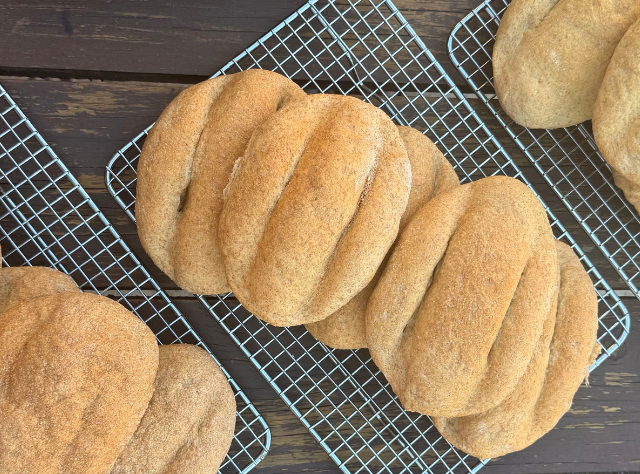
Telera Integral
Fermented Dough
Welcome to one of Mexico’s most iconic bread rolls. The telera has become synonymous with the Mexican torta and countless regional sandwiches. Its light crust and tender crumb structure make it the perfect foundation for a wide variety of fillings and one of the most versatile breads found in the Mexican bakery. As a result, we had to include this foundational recipe in Chapter 7 of The Mexican Bakery.
While the exact origin of the name telera remains uncertain, its roots are generally associated with the Spanish baking traditions introduced to Mexico during the colonial period. Many bakers have also connected the telera’s distinctive three-panel shape with the montera, the traditional hat worn by Spanish bullfighters. Whether historical fact or enduring bakery tradition, the comparison reflects the Spanish influence that helped shape one of Mexico’s most recognizable breads.
In this series, we take the traditional telera in a more wholesome direction by preparing the telera integral at three different levels of whole-wheat flour: 30%, 50%, and 100%.
All three versions use 500 grams of total flour. The primary differences are the ratio of all-purpose flour to whole-wheat flour and the amount of water required. As the percentage of whole wheat increases, additional water is needed to compensate for the greater absorption of the bran and fiber.
The 30% whole-wheat version is the style most commonly found in panaderías. It maintains much of the lightness and volume of a traditional telera while introducing the flavor and nutritional benefits of whole wheat. The 50% version offers a more pronounced whole-grain character, while the 100% whole-wheat telera produces a heartier bread with a denser crumb and deeper wheat flavor.
Increasing the whole-wheat content affects more than the color and flavor of the finished bread. It also influences dough development, water absorption, fermentation, volume, gluten strength, and crumb structure. Bran absorbs additional water and can interfere with the continuity of the gluten network, making proper hydration especially important when developing whole-wheat breads.
By adjusting the flour ratios and hydration, bakers can create different styles of Telera Integral while maintaining the recognizable shape and identity of this traditional Mexican roll.
These three formulas demonstrate how a classic bread can continue to evolve, offering more whole-grain options without losing its connection to the traditions of the Mexican bakery.
Why Does Whole-Wheat Dough Require More Water?
As the percentage of whole-wheat flour increases:
The bran and dietary fiber absorb and retain more water.
Bran competes with the gluten-forming proteins for available water, which can slow gluten hydration and development.
Bran particles can mechanically interfere with the continuity of the gluten network.
Whole-wheat flour dilutes the concentration of gluten-forming proteins found in the refined portion of the flour.
A weaker or less continuous gluten network retains fermentation gases less efficiently, potentially producing a denser loaf with lower volume.
Increasing the water helps hydrate the bran and keeps the dough from becoming excessively stiff, but it does not completely eliminate the structural effects of the bran.
Hydration Guideline
For this series of formulas, increase the water by approximately 2% of the total flour weight for every additional 10 percentage points of whole-wheat flour.
Because each formula contains 500 grams of total flour, a 2% increase in water equals approximately 10 grams or 10 milliliters of additional water.
Example:
30% whole wheat: 350 ml water
40% whole wheat: approximately 360 ml water
50% whole wheat: 370 ml water
60% whole wheat: approximately 380 ml water
70% whole wheat: approximately 390 ml water
80% whole wheat: approximately 400 ml water
90% whole wheat: approximately 410 ml water
100% whole wheat: 420 ml water
This is a practical starting guideline. The exact amount of water may need to be adjusted depending on the brand of flour, the coarseness of the whole-wheat flour, storage conditions, and the baker’s preferred dough consistency.
Ingredients
Telera Integral: 30% Whole Wheat
350 grams (2 1/4 cups) unbleached all-purpose flour
150 grams (3/4 cup) whole-wheat flour
350 milliliters (1 1/2 cups) water
21 grams (2 tablespoons) instant dry yeast
15 grams (1 1/2 tablespoons) granulated sugar
15 grams (1 1/2 tablespoons) brown sugar
10 grams (2 teaspoons) salt
20 grams (2 tablespoons) vegetable shortening
Whole-wheat content: 30%
Water: 350 milliliters
Hydration: 70%
Telera Integral: 50% Whole Wheat
250 grams (1 3/4 cups) unbleached all-purpose flour
250 grams (1 3/4 cups) whole-wheat flour
370 milliliters (1 2/3 cups) water
21 grams (2 tablespoons) instant dry yeast
15 grams (1 1/2 tablespoons) granulated sugar
15 grams (1 1/2 tablespoons) brown sugar
10 grams (2 teaspoons) salt
20 grams (2 tablespoons) vegetable shortening
Whole-wheat content: 50%
Water: 370 milliliters
Hydration: 74%
Telera Integral: 100% Whole Wheat
500 grams (3 1/2 cups) unbleached all-purpose flour
420 milliliters (1 3/4 cups) water
21 grams (2 tablespoons) instant dry yeast
15 grams (1 1/2 tablespoons) granulated sugar
15 grams (1 1/2 tablespoons) brown sugar
10 grams (2 teaspoons) salt
20 grams (2 tablespoons) vegetable shortening
Whole-wheat content: 100%
Water: 420 milliliters
Hydration: 84%
Equipment:
6-quart electric stand mixer with paddle and dough hook attachments
Handheld wire whisk
Dough thermometer
One plastic dough scraper
Digital scale with gram capabilities
2-quart bowl
Plastic wrap
Wooden dowel or rolling pin
6, ¼ sheet baking trays or 3, ½ sheet baking trays
Dough Mixing Procedure
Using a measuring cup or small scoop, start by pouring the flours into the stand-mixer bowl.
Add the dry yeast over the flour and mix thoroughly by hand using the wire whisk.
Add the sugars to the flour mixture and continue to whisk carefully.
Place the bowl onto the stand mixer and add the paddle attachment.
On low speed, gradually add half of the water. Stir for 1 minute.
Add the salt and shortening and continue to mix for 30 seconds on 4th speed.
Add the remaining water while stirring. 30 seconds. Switch paddle to dough hook.
Using the dough hook, knead on medium speed until the dough is cohesive, but still quite soft. Mix on 4th speed for 20 minutes.
While dough is mixing, grease 3 pans (13” x 9.5”) by lightly spreading shortening (non-stick spray not recommended as the dough will slide around during processing). Set aside.
If dough is still tacky, dust the countertop with flour.
Remove the dough from the mixer bowl using the plastic dough scraper.
Shape and round the dough using a tuck-and-pull method.
Place the dough in a greased bowl. Cover tightly with plastic wrap and set aside.
The dough can be refrigerated at this point (not to exceed 8 hours).
Telera Shaping & Baking Procedure
Dust the countertop with whole wheat flour.
Remove the dough from the bowl after 30 minutes, or from the refrigerator after an overnight fermentation.
Once dough has fermented, remove plastic wrap and invert onto a floured surface.
Fold-in four corners of dough to form a bundle, and invert.
Flatten dough to form a rectangle.
Using the plastic dough scraper, divide the dough into three equal strips.
Cut the dough strips into pieces and use the digital scale to precisely weigh the dough pieces at 100 grams for a total of 9, 100-gram dough pieces.
Add some shortening to your hands and round the dough pieces tightly, then gently form into oval-shaped dough balls.
Place all oval-shaped dough pieces on a greased baking pan. Using a towel, remove all shortening from hands.
Cover tightly with plastic wrap.
Let dough rest (relax) for an additional 10 to 15 minutes.
Scrape any shortening or dough residue from the countertop using the plastic dough scraper.
Take 1 cup of whole wheat flour and make a mound on your countertop (work bench).
Remove one oval-shaped dough piece and gently cover with whole wheat flour.
Place the dough piece in the center and flatten using both hands, leaving a mound in the center of the dough.
Using the wooden dowel, press and slightly roll twice over the oblong dough piece.
Place three whole wheat teleras per ¼ sheet tray.
Cover using a cloth or plastic wrap.
Let rest for 60 minutes, or until doubled in size. Slightly mist the whole wheat teleras before placing in the oven.
Open the oven door and carefully place the tray in the oven.
Close the oven door and bake for 9 minutes at 400°F/204°C.
Carefully rotate the tray and continue to bake for 9 minutes or until desired crust color is achieved.
Using oven mitts, remove the tray from the oven and place it over a cooling rack. The teleras can be enjoyed hot out of the oven.
Once cooled can be placed in a plastic bag and stored for up to 3 days or frozen for one week.
More posts and recipes!

Alex Peña
“Baking is the most rewarding part of my culinary experiences.”
Subscribe
Get baking updates!

Take the traditional telera in a more wholesome direction by preparing this telera integral recipe with the option of using three different levels of whole-wheat flour: 30%, 50%, and 100%.